



Vitalik Buterin has referred to as for a tough ceiling on Ethereum proving prices per unit of block fuel, including a resource-accounting take a look at to the push for sooner zero-knowledge proofs. For unbiased prover operators, the problem is how a lot work the toughest permitted block might demand, even when atypical blocks end rapidly.
In his October 15 post, Buterin congratulated ZKsync’s Airbender crew and set out three formal-verification priorities: matching the mathematical illustration of execution to Ethereum’s specification, bounding prover price relative to dam fuel, and securing the proof system itself.
The price requirement reaches past a pace leaderboard. Gasoline provides Ethereum a option to account for work and restrict a block’s useful resource consumption. A helpful proving certain must join that allowance to the assets wanted to provide a proof, together with for intentionally troublesome workloads.
Safety was already a precedence. The Ethereum Basis set out a security-focused phase in December 2025. The present query is whether or not the accounting that helps increased execution capability also can maintain the proving burden predictable.
Quick proofs and the toughest permitted blocks
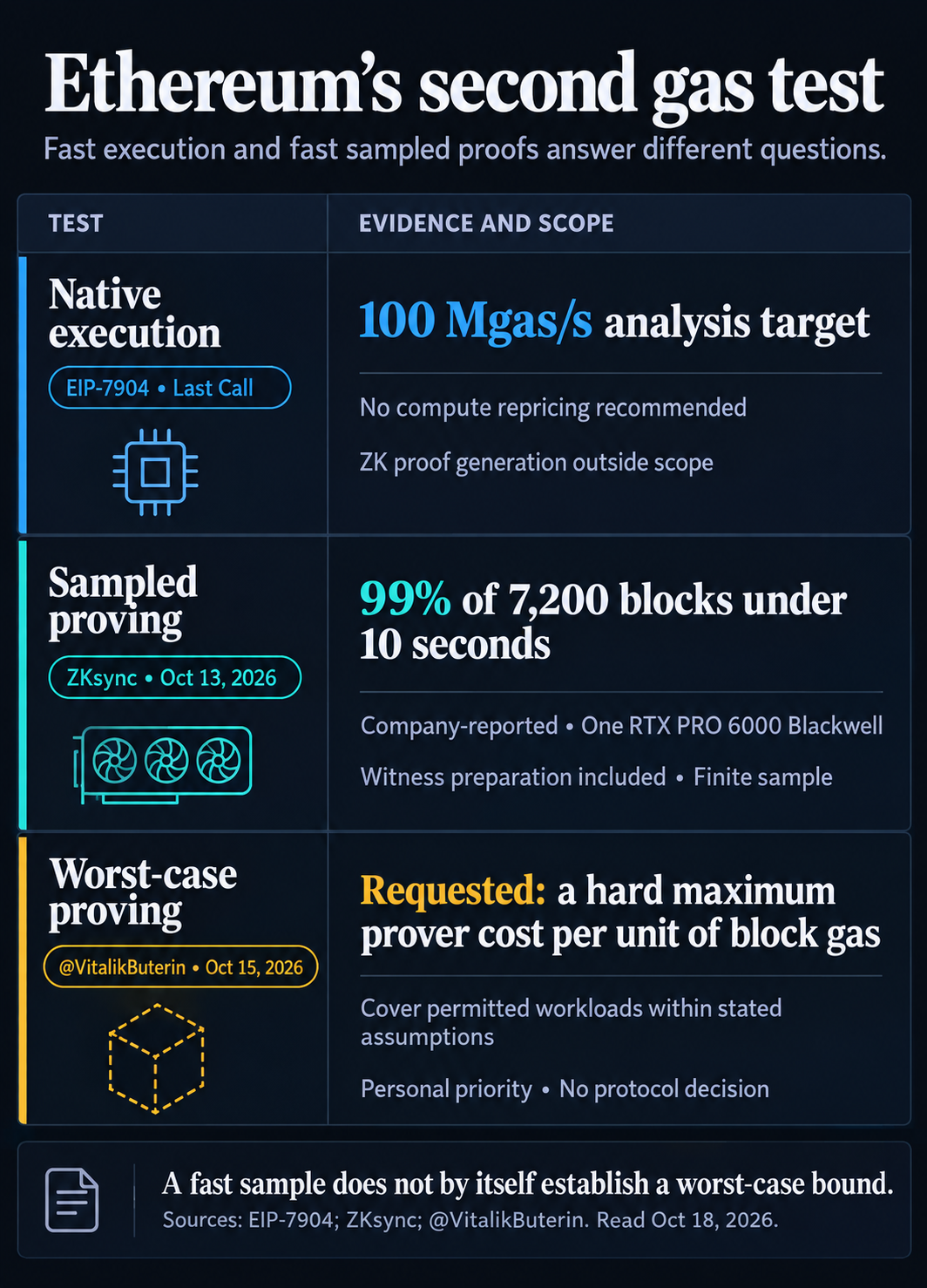
The present compute-cost analysis in EIP-7904 recommends no compute gas-cost adjustments. As of October 18, it’s an Informational EIP in Final Name, with a November 1 deadline.
Its evaluation targets 100 million fuel per second on optimized native execution purchasers. The doc attributes its modified conclusion to optimizations enabled by Block-Stage Entry Lists, together with parallel work that makes beforehand problematic operations sooner. It specifies no adjustments to Ethereum’s fuel schedule.
That conclusion has an outlined scope: execution measured on a naked CPU. EIP-7904 expressly says it doesn’t particularly handle ZK-SNARK proof era. CPU execution and proof era impose totally different workloads.
ZKsync’s single-GPU evaluation demonstrates the progress on the proving facet. In its October 13 announcement, the corporate reported that one NVIDIA RTX PRO 6000 Blackwell proved 99% of seven,200 consecutive Ethereum mainnet blocks in underneath 10 seconds every, together with witness preparation. Each sampled block completed in underneath 12 seconds.
The announcement additionally described separate dwell ETHproofs configurations utilizing two and 4 GPUs.
The pattern information efficiency on these blocks. A maximum-cost assure should cowl each permitted workload inside its acknowledged assumptions, together with blocks intentionally assembled to be costly to show.
For an operator budgeting {hardware}, that distinction issues. A typical block might match comfortably inside a small setup whereas a troublesome authorized workload determines the reserve capability wanted to maintain producing proofs on time.
The workload issues as a result of a unit of execution fuel can correspond to totally different quantities of proving work. In January 27 measurements, Nethermind Analysis’s Lin Oshitani discovered that cryptographic precompiles and several other modular arithmetic or division operations had been comparatively costly to show per fuel. Prices various by prover, and ZK-cycle counts didn’t translate into uniform elapsed proving time throughout operations.
The examine estimated marginal proving time by various operation counts whereas holding surrounding execution context fixed. It examined SP1 v5.2.3 with sp1-cluster and RISC0 v3.0.4, utilizing reth v1.9.3 and 4 NVIDIA GeForce RTX 4090 GPUs. RISC0 used the RISC0_KECCAK_PO2=15 setting.
The measurements used fastened consultant or best-effort worst-case inputs. They omitted block-header validation and by accident omitted BLOCKHASH; a full investigation of argument-dependent prices remained future work.
A stronger certain wants a specified efficiency envelope. The Ethereum Basis’s January worst-case benchmarking framework relates the required proving throughput to a selected block fuel restrict and proving deadline. Below that strategy, a troublesome block should nonetheless match the supposed {hardware} and time finances.
The framework additionally explains why an operation-by-operation estimate wants an end-to-end verify. Proof era has fastened overhead, aggregation could be nonlinear, and {hardware} configuration and safety parameters have an effect on efficiency. The set of execution purchasers and proof programs anticipated to take part additionally issues.
How the alternatives attain operators and customers
The engineering response determines the place the burden lands. Enhancing an costly circuit or execution path might cut back proving work whereas leaving the transaction’s execution fuel items unchanged. Operators might then want fewer assets for a similar workload.
Nethermind’s examine additionally outlined weighted ZK-gas metering with a per-block ceiling. Such a system would depend proof-heavy operations in opposition to a separate allowance, doubtlessly constraining a block earlier than its atypical execution-gas allowance was exhausted. Its safety would depend upon how properly the weights captured troublesome inputs.
Economically, a useful resource cap and a cost rule reply separate questions. A cap can decide how a lot work is admitted with out specifying what an software person pays or what a prover earns. Charging for a proving useful resource would require extra design decisions.
EIP-7999’s multidimensional fee-market proposal stays Draft and separates calldata into its personal useful resource.
Opcode repricing would function by way of the present fuel allowance. Assigning extra fuel to costly operations would enable fewer of them right into a block at a hard and fast fuel restrict. Functions utilizing these operations might eat extra fuel for a similar profitable execution.
Below the execution-fee mechanism specified by EIP-1559, charged fuel is multiplied by the efficient fuel worth. At an unchanged constructive efficient fuel worth, an software charged extra fuel for a similar profitable transaction would pay extra.
The present optional execution-proof proposal, EIP-8025, stays Draft, offers no prover incentives and retains re-execution even when proofs can be found. The Basis’s September priorities place obligatory proofs later, with fork ordering underneath evaluation.
EIP-7904’s November 1 evaluation deadline considerations its CPU evaluation. For unbiased provers, the consequential subsequent step is a certain tied to express workloads, implementations, safety settings and {hardware} assumptions. That might flip a fuel allowance right into a reliable restrict on the proving assets an operator should be prepared to provide.
