

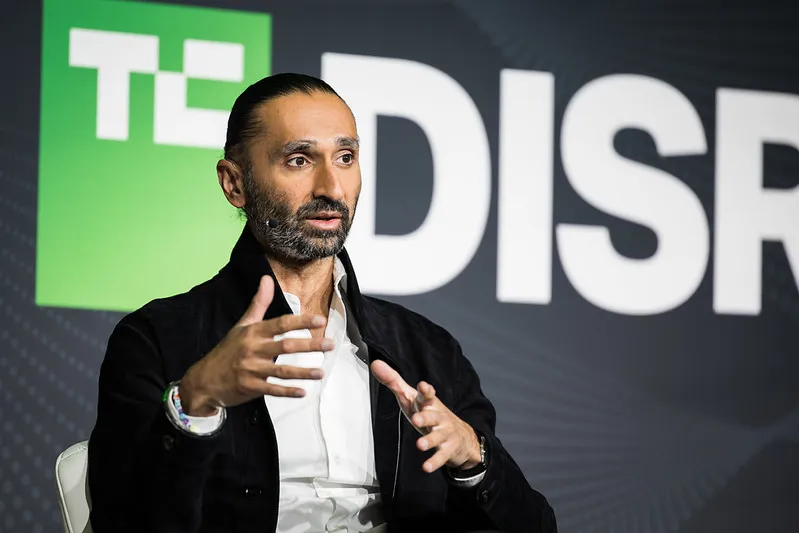

Personal fairness big Blackstone is placing itself on the middle of the AI growth, agency veteran Jas Khaira mentioned final week on stage at TechCrunch Disrupt.
It’s writing checks by way of varied methods, starting from providing huge loans to information facilities to investing in frontier AI fashions and functions.
Earlier this yr, the agency launched Blackstone N1 (BXN1), a San Francisco-based central hub for its AI initiatives. The group is led by Khaira, who relocated from New York to be on the epicenter of AI.
In contrast to earlier tech cycles comparable to cell or SaaS, which allowed corporations to achieve vital scale with reasonable capital, the transition to AI requires staggering quantities of funding. That want for capital is exactly why Blackstone, with its $1.3 trillion in property underneath administration, may play such a crucial position on this tech shift.
Khaira emphasised that Blackstone units itself other than conventional enterprise capitalists by way of its give attention to compute financing and its potential to supply versatile capital buildings, starting from debt to fairness. And it has been investing aggressively.
“We’re the biggest proprietor of compute outdoors of the hyperscalers in the present day, whether or not it’s investments in neo clouds, investments in information facilities, and having the ability to use that compute strategically to help corporations,” Khaira mentioned.
As an example, BXN1 performed a key position in a number of compute-related offers, amongst them Crux AI, a neocloud launched in partnership with Google to commercialize its customized TPUs, to which Blackstone dedicated $5 billion as an investor. It additionally backed four-year-old Etched, a chip startup whose speedy improvement has caught investor consideration. Neoclouds are cloud suppliers that lease out AI GPU infrastructure.
Blackstone pioneered a financing construction that allowed it to lend huge sums to venture-backed cloud neoclouds by analyzing each dedicated buyer contracts and utilizing GPUs pledged as collateral.
Blackstone’s first such deal got here in 2023 with CoreWeave, shortly after that neocloud noticed demand explode following the launch of ChatGPT. Regardless of having solely “30 million of income and minimal profitability” at the moment, in keeping with Khaira, CoreWeave approached Blackstone for a $2.3 billion mortgage.
CoreWeave was borrowing in opposition to the appreciable worth of its giant assortment of Nvidia GPUs, with Nvidia additionally an investor. Blackstone additionally grew extra comfy with the mortgage as a result of CoreWeave had contracts with blue-chip customers like Microsoft.
That transaction rapidly grew to become the financing mannequin for the way Blackstone and different credit score establishments offered billions in follow-on debt to CoreWeave and rival neoclouds.
“One of many main issues that we’re seeking to is the character of the shopper. And if the shopper is an investment-grade buyer — let’s say it’s Microsoft or let’s say it’s Meta — the chance will get priced relative to that buyer,” Khaira mentioned.
Constructing on its success with CoreWeave, Blackstone struck different neocloud financing offers, together with co-leading alongside Coatue a $10 billion credit facility for Australian GPU supplier Firmus earlier this yr.
Khaira acknowledged that in current weeks, the massive debt burdens amassed by these corporations and different neocloud operators have begun to boost pink flags. Coreweave’s debt alone has since ballooned to about $50 billion, inflicting Altimeter Capital founder Brad Gerstner to notice in a current CNBC interview, “The collateral that CoreWeave is placing up which is basically solely GPUs just isn’t ok anymore. They used that previously to get low-cost debt.”
Khaira mentioned that on the credit score aspect, the market jitters stem from a mix of things. Rates of interest ticked up in September, and hotter-than-expected inflation indicators that borrowing prices might hold climbing. The flood of AI infrastructure debt choices isn’t serving to both.
“We’re additionally seeing increased credit score spreads,” Khaira mentioned, explaining that lenders are charging increased premiums on prime of already increased base rates of interest to finance the AI buildout. “The price of capital to cost in debt for a Meta or a Microsoft has widened out,” he added, declaring that even tech giants with huge stability sheets and strong earnings are paying extra to borrow.
Issues in regards to the rising value of debt have spilled into the inventory market. Shares of CoreWeave dropped over 20% in current days, whereas Firmus scrapped its deliberate IPO on the Australian Securities Alternate at a goal valuation of roughly $30 billion.
“In the end, the market wasn’t there at that valuation, and so I believe in consequence, that deal didn’t get achieved,” Khaira mentioned about Firmus’ cancelled itemizing.
“The market is considering what’s the proper value for neoclouds, what’s the proper value for these companies on this second when rates of interest are transferring up,” he mentioned.
Regardless of these pressures on some infrastructure suppliers, AI corporations merely can’t get sufficient compute to energy their fashions. Their urge for food continues to drive information middle buildout.
Khaira downplayed worries of doom-mongers that the huge accumulation of AI infrastructure debt may result in a widespread credit score disaster, or worse, crash the economic system altogether. “This doesn’t really feel like one thing the place you’ve received 2008 banks which are shaky credit,” he mentioned.
As an alternative, he identified that as a result of the overwhelming majority of knowledge facilities are constructed for hyperscalers, the debt financing them is in the end backed “by probably the most creditworthy corporations on the planet.”
Past funding information facilities, Blackstone helps corporations undertake AI by way of a $1.5 billion joint venture known as “Ode with Anthropic,” shaped alongside Anthropic and Hellman & Friedman this yr. Ode provides forward-deployed engineers to assist corporations undertake AI and combine it into their operations, beginning with Blackstone’s 280 portfolio corporations.
When requested if Blackstone-owned corporations are seeing tangible beneficial properties from AI, Khaira conceded that “there’s undoubtedly ROI, however it’s uneven.” He described know-how adoption as one thing that might transfer in a “sawtooth-type sample,” which, to skeptics, can appear like an oversupply of compute earlier than adoption catches up.
If you buy by way of hyperlinks in our articles, we may earn a small commission. This doesn’t have an effect on our editorial independence.
