



Paolo Ardoino’s push to deliver AI into Bitcoin mining has a human choice at its heart: who could authorize a machine to alter what it’s doing? Tether’s MDK v0.11 reference agent pauses its device-action device for human approval, whereas the location should set up who’s entitled to offer it.
That distinction issues as Tether announced commitments from 15 industry participants on October 24 to construct and preserve integrations with its Mining Improvement Package, an open-source framework connecting mining tools, swimming pools and functions. A typical interface can provide software program a constant approach to attain totally different programs. Permission to behave nonetheless is dependent upon the set up.
The v0.11 instance doesn’t set up which code QVAC or collaborating mines have put in. Newer main-branch code provides caller restrictions absent from that tag. Web site management due to this fact activates each who could concern instructions and which upstream software program the mine adopts.
From integrations to tools instructions
Tether’s record consists of BITMAIN, MicroBT, Canaan, Bitdeer, Foundry Digital and Luxor Know-how. It additionally names ACME Swisstech, Elektron Vitality, EMCD, F2Pool, Heatbit, OCEAN, Proto, SpiderPool and Stratum V2.
Below the introduced association, individuals will construct and preserve Staff: software program that interprets an organization’s current {hardware}, pool or system interface into MDK’s widespread language. Every firm chooses the capabilities it exposes. An software can then use that interface relatively than require a separate integration for each producer.
Tether says its QVAC mining agent already operates on MDK as an early demonstration. The announcement provides no participating-fleet capability, share of Bitcoin hashrate or measured financial savings.
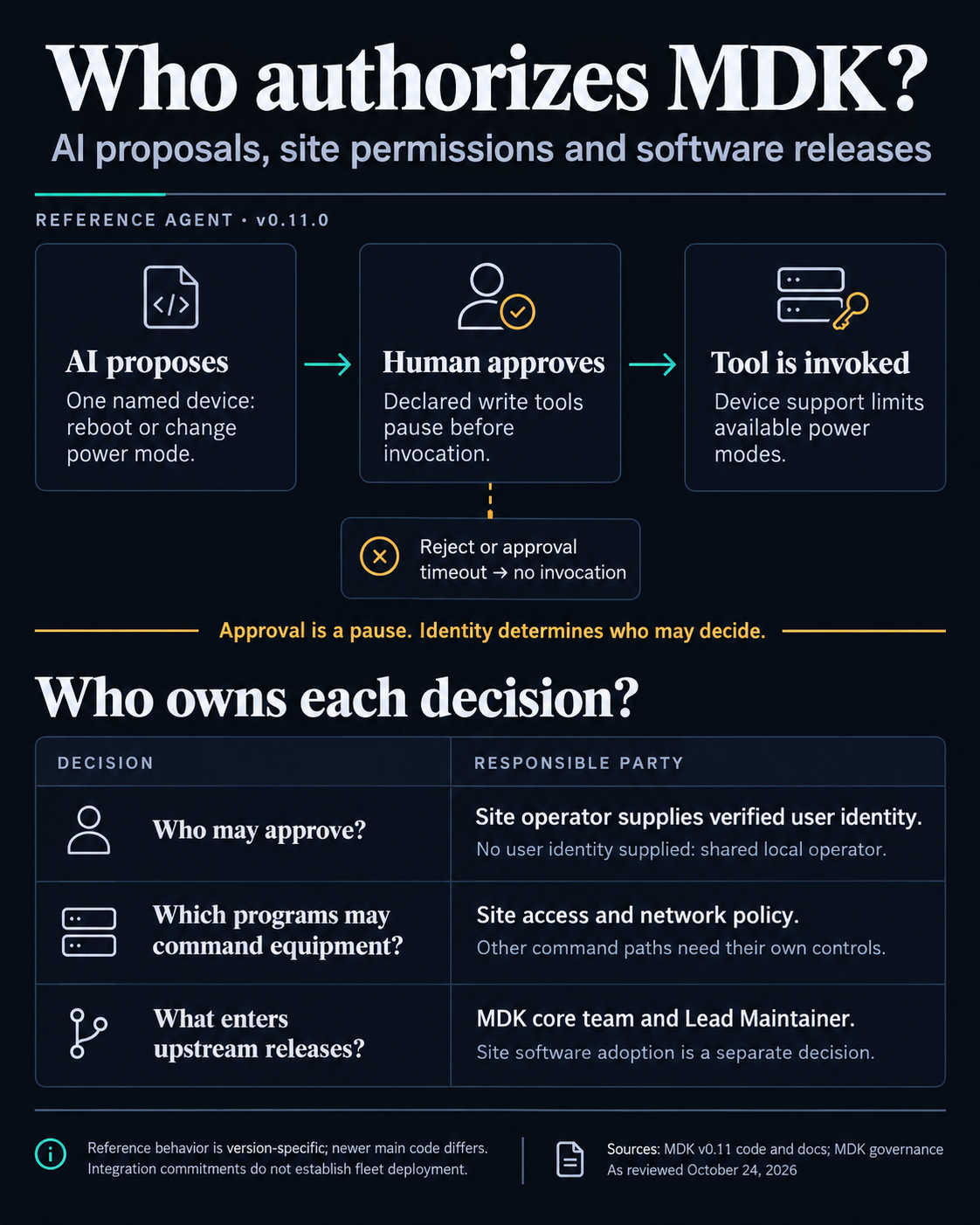
The v0.11 reference site’s action tool accepts one named system and gives two operations: reboot it or change its energy mode. The facility-mode choices are low, regular, excessive and sleep, with the handler checking which modes that system helps earlier than sending the command.
These are the instance’s capabilities, relatively than a ceiling on each software or Employee somebody may construct with MDK.
The reference device is explicitly marked as a write. When the agent’s execution loop encounters a device categorized as requiring approval, it emits a pending-approval occasion and pauses earlier than invoking it. Rejection prevents the decision. The Gateway agent plugin paperwork a default two-minute approval window, with an unanswered request resolving to rejection.
The v0.11 plugin binds periods and approvals to the identification that created them. When no person identification is provided, requests use a shared native operator. In that configuration, an approval pause doesn’t distinguish one human from one other.
A mine assembling this model should due to this fact join its personal identification checks to the approval floor. The particular person allowed to view tools knowledge and the particular person allowed to approve a power-mode change want permissions established by the location.
The identical deployment alternative applies to knowledge. The agent reference helps native QVAC fashions and hosted endpoints; with a hosted supplier, prompts and power outcomes depart the location for that endpoint’s host. Working an agent regionally and selecting the place its mannequin runs are separate configuration selections.
The command path modifications the permission test
The tagged v0.11 safety blueprint distinguishes direct instructions from approval-gated actions. Direct command.request calls haven’t any Kernel-side permission test. The separate motion.push route makes use of permissions provided by an admitted backend caller, so the Gateway, the appliance’s entry level, should derive them from a verified person.
Right here, the Kernel coordinates requests between functions and Staff. A key permitting a backend course of to contact it establishes that course of’s admission. It doesn’t establish the human asking for a change.
The v0.11 Worker implementation provides one other boundary to think about: its community command interface dispatches requests with out checking the caller’s key. The tagged blueprint warns {that a} peer in a position to attain a Employee and tackle its public key can submit instructions immediately. That publicity is dependent upon the community and set up; it doesn’t set up {that a} specific mine exposes its Staff.
Consequently, an approval within the reference chat covers that agent interplay. Limiting each path to tools requires controls across the different entry factors as nicely.
The newer repository code modifications this image. GitHub’s references checked October 24 map v0.11.0 to commit fae8fbce052a and main to 35c144f240f0. On the latter pinned snapshot, Staff require admitted caller keys until an specific allowAll setting is enabled.
| Software program examined | Employee caller test | Working implication |
|---|---|---|
| Tagged v0.11.0, fae8fbce052a | No caller-key test in WorkerRuntime’s RPC entry level. | Community reachability and website controls are materials boundaries. |
| Primary snapshot, 35c144f240f0 | Nonempty admitted-key set at startup, connection firewall and per-request peer-key test, until allowAll is enabled. | With checks lively, revocation restricts subsequent requests on current connections. It doesn’t set up cancellation of dispatched work. |
Its v0.12-labelled changelog additionally describes Kernel roles for studying, writing and administration, opt-in MCP write instruments and declared verification of system state.
In the meantime, the published security guide retrieved October 24 nonetheless describes Staff with out caller allowlists. An operator must match the information to the deployed code earlier than treating both as the outline of a website’s protections.
Launch authority stays with the venture
A mine’s alternative of software program additionally connects it to MDK’s launch governance. The venture’s governance document provides the core staff last venture authority, the Lead Maintainer last technical authority over merges, structure and launch planning, and the Neighborhood Supervisor last authority over strategic route and the roadmap.
An integration dedication doesn’t itself grant a participant authority over MDK’s releases. Equally, authority to merge upstream code doesn’t set up permission to concern instructions inside a mine.
That makes reviewing updates an working duty. The v0.11 security policy says fixes are dealt with on a best-effort foundation for the newest predominant commit and that older commits or tagged releases could not obtain them. Selecting a model pins the location’s code baseline, whereas configuration determines how that code is used. Subsequent modifications want their very own assessment.
The newer changelog’s distinction between command acceptance and affirmation of the ensuing system state illustrates what’s at stake. Permission to ship a power-mode instruction and proof that the machine reached the requested mode reply totally different operational questions.
A mine’s autonomy is dependent upon who can approve writes, which backend packages can attain tools, and who adopts software program updates.
