


Britain’s grid operator forecasts about £4 billion in prices from transmission bottlenecks in 2027, placing a sensible query to Bitcoin mining’s flexible-power pitch: can miners reduce prices by utilizing Scottish wind that can’t attain different shoppers?
The Nationwide Power System Operator (NESO) revealed the forecast on Nov. 12. Its newest value breakdown exhibits why the reply relies on the place a mine connects and which expense it truly avoids.
Thermal constraints come up when transmission strains can not safely carry all of the accessible electrical energy. NESO can then pay turbines to scale back output whereas securing substitute provide elsewhere.
The forecast issues thermal constraints, reasonably than all electrical energy balancing prices. It’s delicate to fuel costs and community availability. NESO estimates prices can be 16% decrease with out community outages, though these outages additionally allow reinforcement supposed to ease future bottlenecks.
In its Nov. 9 outturn explanation, NESO reported complete balancing prices of about £3 billion for 2025/26, together with roughly £2 billion for thermal constraints. A little bit beneath £500 million was paid to wind farms to show down.
Round 75% of thermal constraint prices paid for substitute power, predominantly from fuel items.
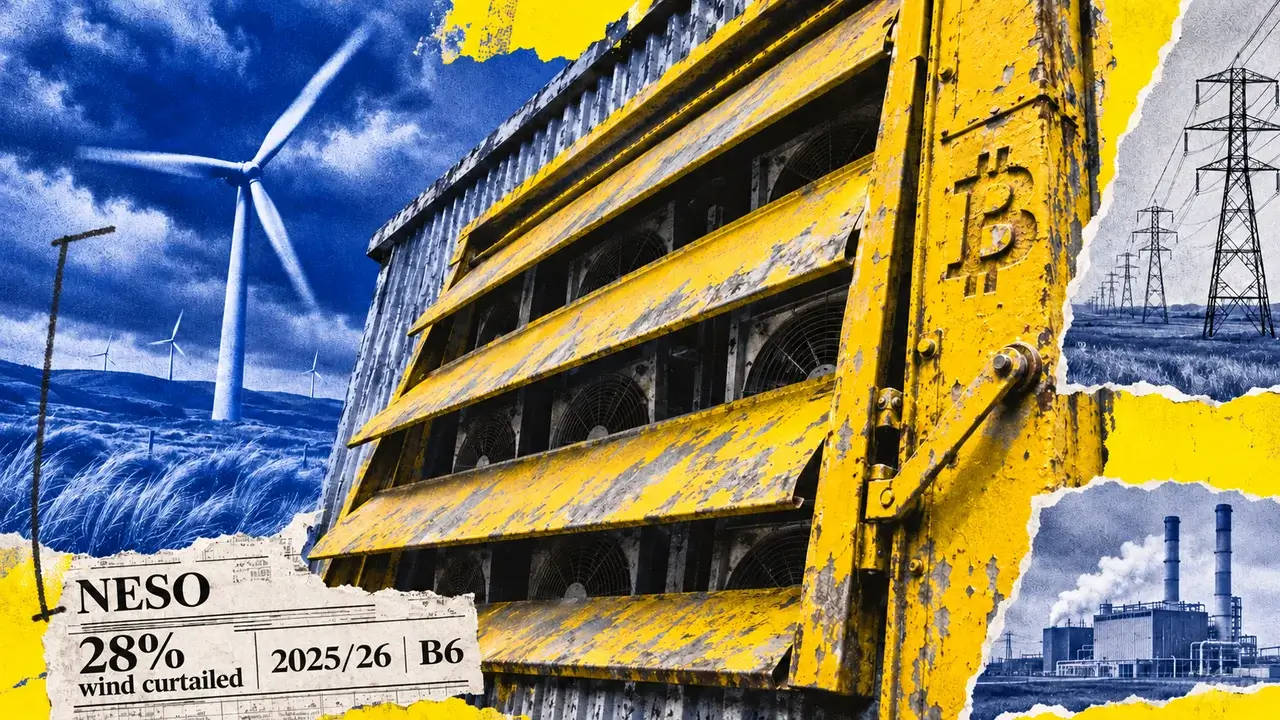
Scotland nonetheless presents a possible use case. NESO says 28% of wind within the northern space above a transmission boundary often known as B6 was curtailed in 2025/26, in contrast with 13% throughout Nice Britain.
A versatile mine might scale back wind turn-down prices by consuming in any other case curtailed electrical energy at a connection and time that helps handle the related bottleneck. However including northern demand doesn’t itself ship extra energy south. Whereas the boundary stays binding and southern demand is unchanged, substitute provide stays mandatory there.
That limits the financial savings declare: decreased wind turn-down doesn’t set up an equal discount in fuel technology, client payments or emissions.
02 / Observe the constrained energy
Illustration: wind is curtailed behind a binding boundary; substitute provide nonetheless serves unchanged southern demand.
Illustration: mining makes use of some surplus behind a binding boundary; substitute provide nonetheless serves unchanged southern demand.
A neighborhood mine could scale back wind turn-down prices whereas substitute provide remains to be wanted past the bottleneck.
The 2025/26 share will not be a 2027 breakdown. Mining state is conditional on appropriate connection, timing and dispatch. No Bitcoin-specific approval, fee entitlement, fuel saving or client profit is established.
Utilizing wasted wind wants a enterprise case
The Cambridge Centre for Alternative Finance’s mining survey presents proof that miners can alter consumption. Respondents reported curbing 888 GWh {of electrical} load throughout 2023. That measures demand turned down, whereas absorbing surplus Scottish wind would require demand to show up on the proper location and time.
The survey coated 49 companies representing 48% of Bitcoin’s community hashrate at assortment, with exercise concentrated in North America. It doesn’t set up worthwhile intermittent mining in Britain. Electrical energy accounted for greater than 80% of surveyed miners’ cash-based working bills.
NESO’s November thermal constraints report identifies further versatile demand in constrained areas as a mitigation. Its March 5 proposed Demand for Constraints design centered on Scottish boundaries. It contemplated registration and dispatch by way of the Balancing Mechanism, NESO’s system for guiding electrical energy provide and demand in actual time, with routes for each new connections and present property creating further versatile demand. The March design proposed service deliveries from 2028, after the yr coated by the forecast. It didn’t set up a Bitcoin-specific approval or fee entitlement.
For a mine, a usable connection, service qualification and sufficient working hours to cowl prices would all matter. For shoppers, the related comparability is the expense truly averted after accounting for the prices the mission provides.
NESO’s take a look at is total system value. The roughly £4 billion forecast identifies the size of a grid downside; it doesn’t value a mining answer.
