



Ethereum validators depend on independently constructed consensus shoppers to agree on the chain, and that variety is a security characteristic. If a defect impacts a consumer utilized by an excessive amount of of the community, Ethereum can cease finalizing blocks or, below extra excessive situations, finalize the fallacious chain.
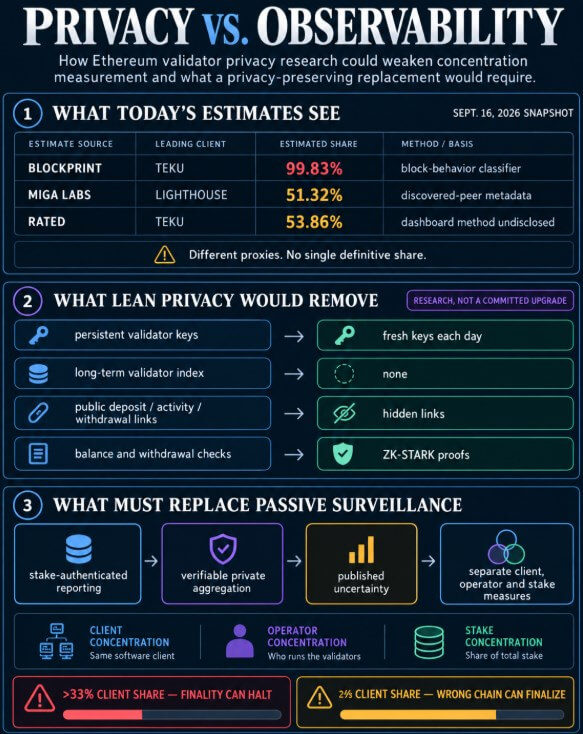
But a Sept. 16 snapshot of 1 client-diversity dashboard supplied three incompatible solutions about which consumer had the biggest share. Clientdiversity.org confirmed Blockprint estimating Teku at 99.83%, Miga Labs estimating Lighthouse at 51.32%, and Rated estimating Teku at 53.86%.
These are readings coming from totally different proxies, and one is hooked up to a device its developer now calls defunct. Ethereum researchers are exploring stronger validator privateness.
A Lean-chain research proposal would use recent validator keys every day and conceal hyperlinks between deposits, validator exercise and withdrawals, weakening a number of the traces used to measure operator and stake focus.
The central query is whether or not Ethereum can substitute imperfect surveillance with authenticated combination reporting earlier than these persistent identifiers disappear.
Why the disputed numbers matter
Ethereum.org’s client-diversity guidance describes two distinct failure ranges.
A bug in a consensus consumer utilized by greater than 33% of nodes might forestall finality, a liveness failure that leaves customers unable to depend on transactions as irreversible.
A important bug in a consumer with a two-thirds majority might trigger an incorrect break up chain to finalize, a security failure that would go away validators going through slashing or an costly exit-and-re-entry course of.
The general public steering makes use of node share as shorthand. Researchers in search of a consensus-risk measure care concerning the distribution throughout validators and their voting weight, as a result of a easy rely of seen machines doesn’t present how a lot stake backs every consumer.
The Sept. 16 snapshot didn’t present that clear, stake-weighted reply.
| Estimate | Largest displayed consumer | Displayed share | Underlying sign |
|---|---|---|---|
| Blockprint | Teku | 99.83% | Machine-learning classification from block habits |
| Miga Labs | Lighthouse | 51.32% | Shopper metadata from found friends |
| Rated | Teku | 53.86% | Technique not disclosed on clientdiversity.org |
Sigma Prime’s archived repository says the classifier is not correct after Ethereum’s Electra improve and considers the mission defunct. Clientdiversity.org nonetheless labeled the Blockprint panel as up to date day by day.
Miga measures a distinct sign. Its Ant crawler discovers friends and requests consumer metadata. Firewalls, refused connections, discovery gaps, and rotating peer IDs can restrict protection. One node can serve many validators, so a node pattern doesn’t reveal how a lot stake is behind every remark.
Rated’s documentation exhibits a separate attribution drawback. For operator-level evaluation, Rated groups validator keys by deposit address, then maps these teams to entities utilizing transaction analysis, block graffiti and voluntary disclosure.
Rated says there isn’t any customary technique for that higher-order mapping. Its operator attribution shouldn’t be an evidence of the consumer estimate displayed on clientdiversity.org, but it surely exhibits how a lot focus evaluation can depend upon persistent public hyperlinks.
Shopper focus, operator focus and stake focus are associated however not interchangeable. A big operator can diversify throughout shoppers, whereas nominally separate validators can share one operator, internet hosting supplier, or software program stack.
Ethereum Lean privateness would change what observers can measure
Buterin’s July analysis put up proposes shifting a lot of Ethereum’s per-validator accounting into zero-knowledge proofs. Below its privateness section, the lively validator registry could be rebuilt every day, validators would register recent keys, and no long-term validator index would stay.
Steadiness updates and withdrawal situations could be confirmed with ZK-STARKs. Deposits would use hiding commitments so a withdrawal tackle shouldn’t be publicly linked to earlier validator exercise.
Buterin described the outcome as sturdy validator anonymity. Within the dialogue, he additionally acknowledged that privateness can disguise centralization, whereas suggesting that giant operations should still leak sufficient combination knowledge to be identifiable.
Ethereum’s broader privacy roadmap describes a number of protocol modifications as lively work or candidates into consideration, and says the roadmap is unfinished and topic to alter.
Day by day key modifications would disrupt strategies that assume a validator may be adopted over time. Hiding deposit and withdrawal hyperlinks would additionally erode deposit-address grouping utilized in some operator attribution.
Miga’s crawler observes community friends moderately than counting on long-lived validator keys. A block classifier appears to be like for habits moderately than id. Neither technique would routinely disappear as a result of keys rotate, though new protocol and consumer habits might make their alerts much less dependable.
Blockprint’s failure after Electra already exhibits how a protocol change can invalidate a fingerprint.
A 2025 USENIX study reported that 4 observer nodes situated greater than 15% of Ethereum validators within the peer-to-peer community throughout a three-day measurement. That experiment exhibits how community traces can reveal internet hosting focus, but in addition why preserving these traces creates privateness and concentrating on dangers.
A analysis path exists for publishing combination consumer shares with out revealing every validator’s selection, but it surely doesn’t but clear up authentication.
A Nethermind research project explored non-public voting for consumer reporting. Validators might encrypt their consumer selections, show their ballots are structurally legitimate, and permit a set of authorities to get well solely the combination. The design thought-about homomorphic encryption, distributed key technology, and zero-knowledge proofs.
An IETF research draft on verifiable distributed aggregation describes associated cryptographic instruments for personal sums, histograms, groupings, and heavy hitters. These primitives can validate the type of a submitted measurement whereas hiding the person enter.
Multiplexed setups and distributed validators may additionally use a couple of consensus or execution consumer, making an trustworthy report extra complicated than a single label. Nethermind’s put up identifies sampling, pretend knowledge, software program attestation, decryption authorities, and efficiency as unresolved design questions.
Non-public consumer combination reporting might present whether or not a consumer crossed a warning threshold with out revealing particular person validators, but nonetheless miss that one firm managed many unrelated keys. Shopper share and operator share want separate authenticated measurements. Neither the Lean put up nor the private-reporting analysis specifies a whole operator-concentration system.
Ethereum could make validators extra non-public with out abandoning its client-diversity security self-discipline, however measurement should turn into an specific a part of the privateness design. Which means stake-authenticated reporting, verifiable aggregation, revealed uncertainty, and separate therapy of consumer, operator, and stake focus.
Day by day re-anonymization would expose how a lot the present image already relies on incompatible estimates and public traces that privateness analysis is supposed to take away.
