



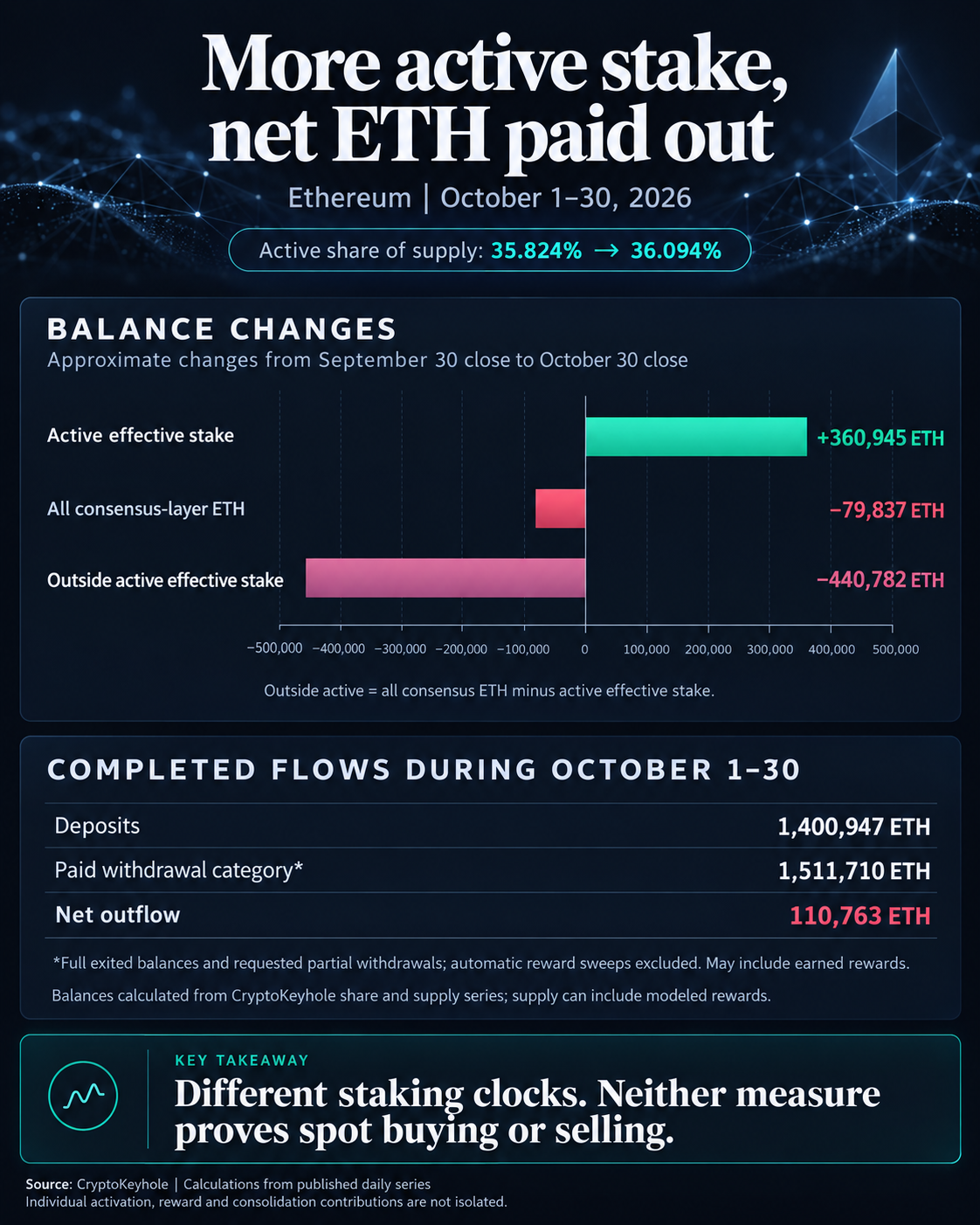
Ethereum staking grew on one measure throughout Oct. 1–30 whilst extra ETH was paid out by way of exits and requested withdrawals than arrived in deposits. Lively stake counts validators securing the community; deposits and funds file actions throughout the staking boundary.
CryptoKeyhole, an analytics supplier that runs Ethereum nodes, studies 1,400,947 ETH deposited from Oct. 1 by way of Oct. 30 and 1,511,710 ETH paid out in its principal-withdrawn class. That leaves a web outflow of 110,763 ETH. Throughout the identical closed-day window, energetic validators’ efficient stake rose from 35.82% to 36.09% of ETH provide.
The excellence issues for traders studying a better staked share as proof of contemporary demand or tightening liquid provide. Extra ETH can depend towards securing Ethereum whereas the broader pool of ETH held on its consensus layer will get smaller.
How Ethereum staking balances diverged
The comparability makes use of CryptoKeyhole’s daily staking-share series and provide knowledge for the 30 full UTC days from Oct. 1 by way of Oct. 30, measured from Sept. 30 near Oct. 30 shut.
Lively stake is the efficient steadiness of validators taking part in consensus: the quantity that counts towards their community weight. The broader consensus-layer measure additionally contains queued deposits, validators ready to activate or be paid after exiting, and balances above the efficient quantity.
Multiplying the supplier’s revealed every day shares by its corresponding provide figures provides the next approximate balances:
| Measure | Sept. 30 shut | Oct. 30 shut | Change |
|---|---|---|---|
| Lively efficient stake | 43,737,996 ETH | 44,098,941 ETH | +360,945 ETH |
| All consensus-layer holdings | 45,584,361 ETH | 45,504,524 ETH | −79,837 ETH |
| Consensus holdings exterior the energetic efficient tally | 1,846,365 ETH | 1,405,583 ETH | −440,782 ETH |
These approximate balances are calculated from CryptoKeyhole’s sequence and rounded to complete ETH. They inherit its supply methodology, which may embody modeled rewards for days whose closing state has not been learn. The ultimate row combines a number of classes; it doesn’t establish every one’s contribution.
About 361,000 ETH extra counted as energetic efficient stake whereas whole consensus holdings fell by about 80,000 ETH. The mixed steadiness exterior the energetic efficient tally contracted sufficient to accommodate each modifications.
A shrinking whole ETH provide doesn’t clarify the upper energetic share on this dataset. CryptoKeyhole’s provide sequence elevated by about 86,137 ETH throughout these closes. Its broader consensus-layer share fell from 37.336% to 37.245%, whilst energetic share elevated.
The flow measure counts deposit requests in every day’s blocks, together with deposits for brand new validators and top-ups to present ones. A request doesn’t instantly grow to be energetic efficient stake. Ethereum’s pending-deposit processing and activation guidelines impose separate steps earlier than that capital can contribute to consensus.
Beforehand deposited ETH can grow to be energetic throughout October with out one other deposit or contemporaneous spot buy. Conversely, an October deposit can stay queued past the month.
Withdrawals have their very own timing distinction. A validator stops contributing energetic stake earlier than its remaining steadiness is ultimately paid to its withdrawal deal with. A cost accomplished in October can thus mirror an exit that affected energetic stake earlier.
How rewards and cost timing change energetic stake
Rewards can even improve energetic stake with out a deposit. Ethereum’s compounding validators can retain rewards and lift efficient balances as much as 2,048 ETH, whereas legacy validators have a 32 ETH efficient cap and routinely sweep extra rewards. Complete-ETH steadiness changes and a buffer additional separate rewards earned from efficient stake added.
CryptoKeyhole excludes automated excess-balance reward sweeps from its principal-withdrawn class. It contains full balances paid to exited validators and partial withdrawals requested from the execution layer. These funds can include accrued rewards, making “principal” a class label fairly than a calculation of authentic deposits alone.
Consolidations additionally require separate accounting. They transfer present stake into fewer validators as a substitute of constituting new exterior deposits. Intermediate modifications in energetic balances and any residual later withdrawal can have an effect on the related tallies with out representing contemporary shopping for.
Activation and cost timing due to this fact assist clarify how the measures can diverge. The combination steadiness modifications don’t allocate the 360,945 ETH improve amongst activation, reward compounding, consolidation results and different effective-balance changes.
The 110,763 ETH circulate deficit additionally measures completely different elements from the change within the full consensus ledger. The latter contains rewards web of penalties and automated payouts, so these aggregates alone don’t totally reconcile the 2.
A deep entry queue nonetheless represents earlier commitments
The entry backlog supplies one other inventory of ETH that should be separated from new deposits. CryptoKeyhole’s closing queue fell from 1,578,359 ETH on Sept. 30 to 1,226,570 ETH on Oct. 30, a decline of 351,789 ETH.
That decline is just not a direct measure of activations. New requests, processing and inner queue actions can change the steadiness alongside the way in which. Equally, the exit queue’s fall from 604,304 ETH to zero doesn’t imply that quantity was paid out through the month.
On the finalized epoch timestamped Nov. 2 at 09:52 UTC, CryptoKeyhole reported 1,104,862 ETH awaiting entry and estimated 19.7 days for a brand new deposit to be credited. This later snapshot supplies context for the backlog; the October comparability makes use of the closed-day balances above.
A zero exit queue additionally leaves later payout steps intact. CryptoKeyhole reported a 27.3-hour withdrawability delay after exiting, adopted by cost on a withdrawal sweep. Its final full sweep cycle took 7.1 days; that historic period is just not a assured ready time for each validator.
CryptoSlate’s October coverage of staking delays distinguished the wait to earn from the levels required to get ETH again. The month-end figures add a separate lesson: a queue, an energetic steadiness and a accomplished cost describe completely different factors in the identical course of.
On the different finish, Ethereum’s withdrawal rules credit score the required execution-layer deal with. That cost alone establishes neither an trade deposit nor a sale.
