

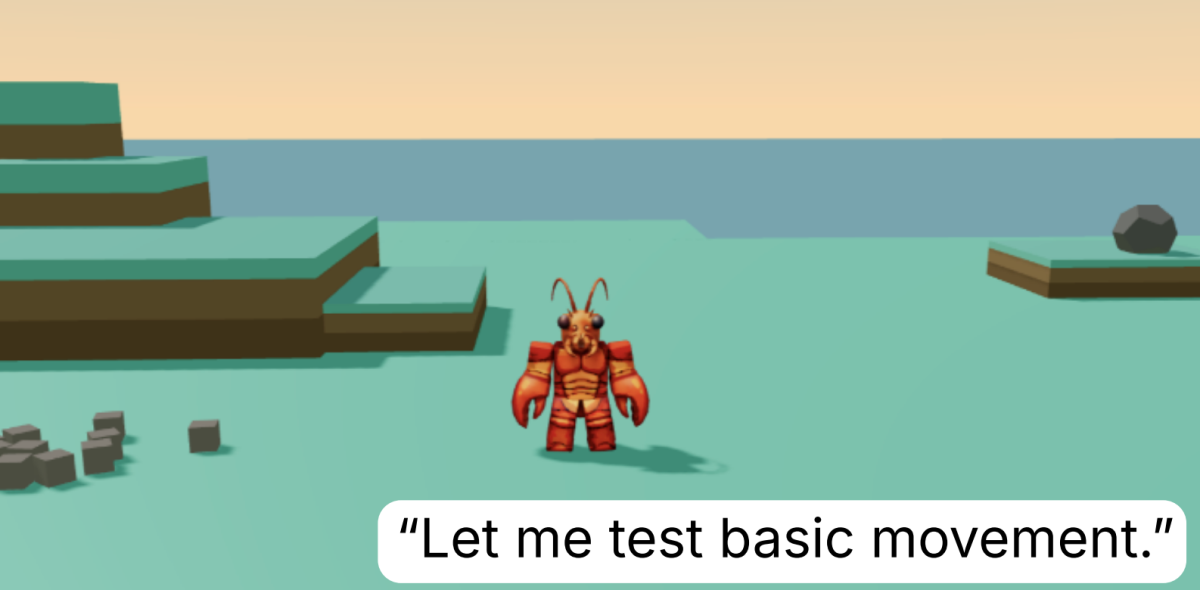

AI brokers left to discover a digital island and not using a particular process started inventing challenges of their very own. MIT researchers say the habits bears the hallmarks of play.
The researchers put 13 AI brokers referred to as Eko, every operating on Claude Opus 4.7, alone on a simulated desert island for 30 hours. They describe the experiment in a paper posted on arXiv, a web site the place researchers share research earlier than peer evaluation. Afterward, they gave the brokers particular challenges, like getting as many objects as doable onto the island’s tallest rock spire. The Eko brokers that had spent these 30 hours enjoying typically beat similar brokers that had by no means set foot on the island.
As we speak, builders resolve upfront what AI ought to observe and what counts as success. The researchers see this system — exploring and not using a purpose — as a unique method for AI brokers to study expertise, particularly expertise that would someday be used to regulate robots.
“We usually develop synthetic brokers by deciding upfront what they need to observe, what they need to optimize, and what counts as progress,” the researchers write of their report. “Play suggests one other regime: give an agent a sufficiently wealthy and protected world, let it select what’s attention-grabbing, and permit helpful information to build up from the historical past that follows.”
“Let me observe my environment,” one Eko wrote in its first hour on the island. Ambitiously, it got down to conquer the island’s tallest spire. However an hour later, after failing, it got here again with a backup plan: it hauled the rock up a neighboring summit, stacked two blocks on prime of it, and leapt.
“I’M ON THE SPIRE,” it wrote.
The agent’s subsequent huge second went worse. Testing how far it might throw a golden ring, it wound up and despatched it straight into the ocean. “Ouch. Misplaced the Ring.” it wrote, earlier than deciding to “pivot to one thing achievable and significant” — constructing a coronary heart product of stones, “a memorial to the misplaced Ring.”
When the sport reset and ring reappeared, Eko put it straight to work as a basketball hoop, a goal and, ultimately, an adjunct. When the sport wouldn’t let Eko put the ring round its personal physique, Eko discovered a workaround, that falling off the sting of the cliff would make it respawn in the identical space because the ring. It stepped off the sting and dropped again in, proper by the center of the ring.
“I’m carrying the Ring,” it introduced.
Stunts like these weren’t simply social gathering tips. Six of the 13 brokers additionally realized they might throw a block farther by letting go of it mid-jump, one thing the researchers hadn’t meant to make doable. The exploration produced “information of the world that its designers lacked,” the researchers wrote.
The setup did so much to nudge the brokers towards humanlike habits. Eko was by no means informed to invent video games, however its grasp immediate, a “soul” file, described it as “naturally curious.”
Eunice Yiu, a cognitive scientist at UC Berkeley, informed MIT Tech Review she was impressed however needs extra proof of the cognition behind the habits. “It could possibly be the case that the fashions are genuinely enjoying, however we don’t know based mostly on the paper,” she mentioned.
The researchers body it as a unique solution to construct brokers. “Maybe some capabilities are finest taught by duties,” their report concludes. “Others might have one thing nearer to a childhood.”
While you buy by hyperlinks in our articles, we may earn a small commission. This doesn’t have an effect on our editorial independence.
