

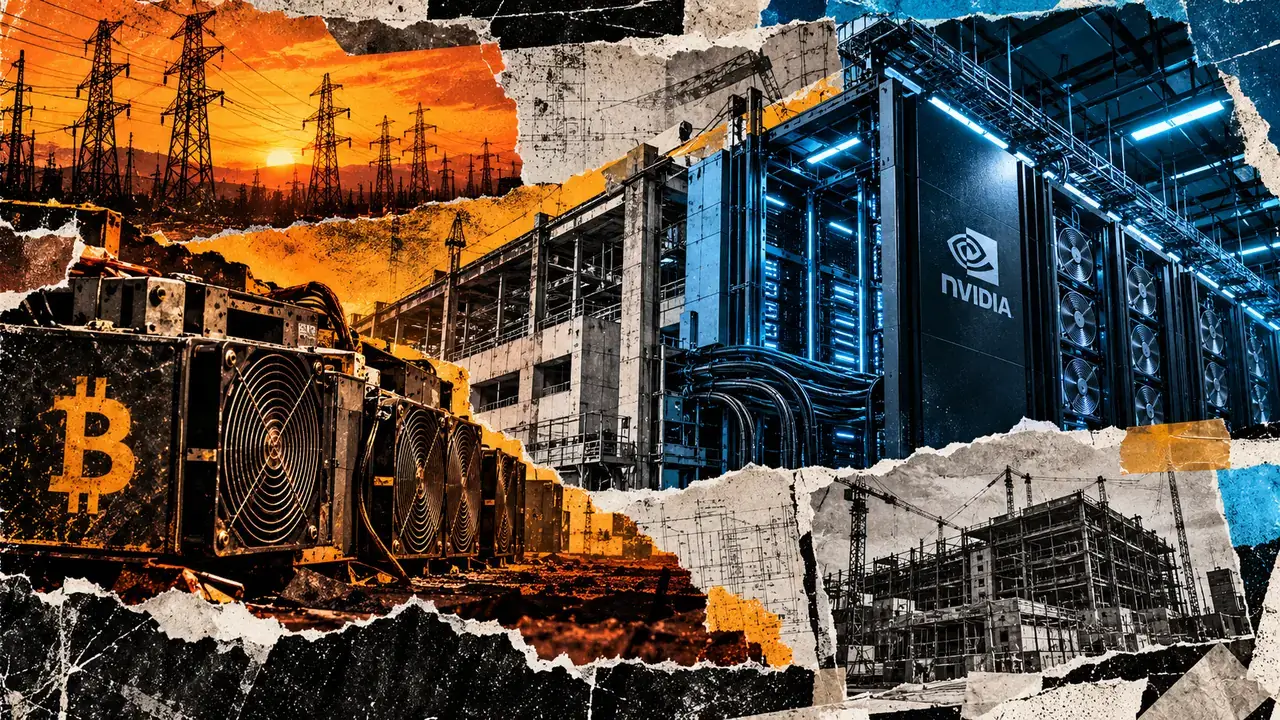

Bitcoin miners spent years securing low cost electrical energy, constructing substations, and negotiating the grid connections wanted to energy their operations. Now AI firms need these connections so badly they’re keen to make getting older mines helpful actual property.
The ASICs that mine Bitcoin are virtually ineffective for coaching AI fashions, however the land, substations, and energy agreements round them might spare data-center builders years of ready.
SWI Group took management of Bitcoin miner Genesis Digital Belongings earlier this 12 months and announced an €800 million capital increase on Oct. 12 to develop its AI infrastructure enterprise.
Two weeks later, it launched SWI Compute, disclosing roughly $1 billion in NVIDIA tools orders and its first prospects, with some contracts nonetheless being finalized.
As part of the fundraising, Genesis is turning into a part of a a lot larger guess on promoting computing energy quite than mining BTC.
It is an irresistible commerce on paper: take an industrial property constructed to devour huge quantities of electrical energy and provides that electrical energy to prospects keen to pay significantly extra for it.
Sadly, you may’t flip Bitcoin mining facilities into AI knowledge facilities simply by plugging totally different computer systems into the wall. The conversion requires intensive retrofits, cooling that may deal with a lot denser {hardware}, refined networking, building financing, and prospects keen to decide to the completed product.
Till the ability is operational, the promised income is simply that: a promise.
Core Scientific’s agreements with AI cloud supplier CoreWeave present the place the cash goes. CoreWeave helps fund building however recovers a few of that contribution via hire credit, whereas Core Scientific borrows billions, builds the services, and dangers penalties for late supply.
That is how a mining property can turn into rather more helpful with out its proprietor receiving something near that worth: electrical energy attracts the purchasers in, however the contracts decide who will get paid.
Bitcoin mining tools is shedding worth
Bitcoin mining is an unforgiving enterprise. Operators run specialised computer systems often known as ASICs, competing for block rewards whose worth is determined by Bitcoin’s worth and the machines’ effectivity relative to the remainder of the community.
They require lots of energy to run, whatever the market, which suggests firms face the identical payments in bull and bear markets. The primary wave of public miners had been seen as leveraged Bitcoin bets establishments might simply make when entry to BTC was onerous or inconceivable.
However the market is a harsh mistress, and these firms now look nothing like leveraged Bitcoin bets. Elevated competitors and the insatiable starvation for AI have pushed a lot of them towards turning into knowledge heart landlords.
Core Scientific’s second-quarter filing places a worth on the previous enterprise shedding its enchantment.
Throughout the first quarter, the corporate wrote down $266.5 million of mining tools and infrastructure as Bitcoin costs, mining income per unit of computing energy, and secondhand tools values deteriorated.
Of that cost, $151.6 million associated to mining machines and $114.9 million to mining infrastructure. In the meantime, its newer AI colocation enterprise was already producing income.
The corporate’s mining operation has been shedding cash on the gross-profit stage while AI hosting earned a positive gross margin.
Mining {hardware} loses worth because it ages, however a working grid connection does not. The truth is, it may turn into much more fascinating as a result of builders cannot simply exit and purchase one.
Utilities nonetheless have to assess transmission capability, establish upgrades, and decide who pays for them. Having sufficient money for GPUs does not make these steps go away.
Electricity access became the miners’ real prize, however the backlog of proposed initiatives additionally makes that entry extremely tough to worth.
In Texas, regulators accredited ERCOT’s Batch Zero review process in June, whereas the state ordered an audit of roughly 474 GW of proposed large-load connections.
Electrical energy already flowing to a facility differs from capability accredited for future use, and each differ from a spot within the connection queue. Grouping them below one headline megawatt determine could make a portfolio seem a lot nearer to producing AI income than it’s.
SWI’s June announcement about Genesis described land with greater than 1.3 GW of energized and accredited connections throughout 15 services. By September, its half-year results described roughly 1.2 GW of secured grid connections.
The disclosures do not reconcile the 2 figures or present a site-by-site breakdown separating at the moment usable capability from energy that requires further work.
SWI additionally did not merely pay a set worth for these megawatts. Its preliminary $500 million funding purchased about 38.3% of Genesis’s fairness and rights to 77.2% of the worth of sure preferred-share liquidation preferences, which govern claims on proceeds quite than abnormal possession.
SWI subsequently took management, however dividing that first fee by 1.3 GW would inform us little about what it paid for deliverable energy.
Even an agreed valuation of the entire firm would not inform us what an working AI knowledge heart prices. Genesis got here with a mining enterprise, tools, land, current electrical belongings, and every kind of rights to future energy.
Nevertheless, these are simply elements, they usually require some huge cash earlier than they’ll really turn into a worthwhile AI enterprise.
Turning a Bitcoin mine into an AI knowledge heart is an costly conversion
Whereas Bitcoin mining services and knowledge facilities would possibly look just like the untrained eye, they’re two very totally different companies.
Bitcoin mines are constructed to run hundreds of unbiased machines that may be switched off when obligatory, whereas AI knowledge facilities want refined cooling, high-speed networking, redundant energy techniques, and far stricter uptime ensures to maintain densely packed GPU clusters working reliably. So buying an current facility is only a head begin.
Information facilities devour electrical energy past what their servers use, significantly for cooling and energy distribution. At an influence utilization effectiveness ratio of 1.25, a web site drawing 100 MW from its electrical provide would ship about 80 MW to computing tools and use the opposite 20 MW to help the ability.
Evaluating that web site’s 100 MW grid reference to a competitor’s 100 MW of usable IT capability would make two very totally different properties appear equal.
Nvidia’s GB300 NVL72 reference structure describes liquid-cooled racks with 72 GPUs that draw up to 142 kilowatts each.
Delivering the electrical energy is just one a part of supporting them, since cooling, networking, and constructing design should additionally meet requirements most Bitcoin mines weren’t constructed for.
CoinShares estimated in its September mining report that changing mining infrastructure to AI-grade services prices roughly $8 million to $15 million per MW, towards $700,000 to $1 million per MW for typical mining infrastructure.
The order of magnitude explains why proudly owning a powered mining web site and proudly owning a accomplished AI facility command such totally different valuations.
A review of more than $100 billion in AI deals discovered that solely round 550 MW was billing out of greater than 4 GW below contract. HIVE’s $350 million AI settlement required an estimated $185 million hardware buildout earlier than most of that income might arrive.
Below colocation preparations, the operator usually offers the buildings, electrical energy infrastructure, cooling, and different companies, whereas the client provides its personal computing tools.
Promoting AI computing capability straight means shopping for GPUs as properly, then discovering sufficient prospects to maintain them occupied whereas newer, extra environment friendly {hardware} makes current techniques much less aggressive.
Core Scientific earns charges for internet hosting different firms’ machines, whereas SWI intends to promote computing itself. Each stand to learn from former mining infrastructure, however their capital necessities and publicity to {hardware} prices differ drastically.
Core Scientific’s contracts present how the AI income will get divided
We are able to get a fairly good thought of the mathematics behind these offers from Core Scientific, as a result of a few of its transformed services are already working and its agreements with CoreWeave spell out the place the cash goes.
It reported $136.7 million of colocation revenue in the second quarter, with 437 MW billing prospects by mid-July.
Its quarterly submitting attributes $98.8 million to license charges and $35.1 million to energy fees handed via to prospects, with the stability coming from different companies. The electrical energy reimbursement additionally seems as an equal expense, so it provides to reported income with out creating gross revenue.
Greater than 1 / 4 of the colocation income due to this fact represents a utility invoice being handed alongside, quite than cash Core Scientific earns for offering the ability.
Inside Core Scientific’s $136.7 million AI colocation quarter
Quarter ended June 30, 2026. Gross revenue, non-power colocation prices and electrical energy reimbursement add to reported income. Gross revenue is earlier than curiosity, company bills, taxes and capital spending. Values proven in {dollars}.
 CryptoSlate
Below terms disclosed in April, many of the CoreWeave websites begin at a base license price of $100 per kilowatt per thirty days, topic to three.5% annual will increase, with CoreWeave accountable for utility prices.
CoreWeave additionally funds or reimburses sure accredited building bills and, for specified landlord-owned tools, receives credit towards future base charges value as much as $1.5 million per MW. These credit can minimize the related month-to-month hire fee in half till the allowance is exhausted.
Take one megawatt on the preliminary $100 fee. Its contractual base price is $100,000 a month, however a 50% building credit score reduces the fee to $50,000.
If the total $1.5 million allowance applies, utilizing $50,000 in credit every month would take 30 months to recuperate it, earlier than permitting for hire will increase and the contract’s different provisions. The client basically pays for the info heart to be constructed, then progressively will get that cash again via decrease funds to the corporate that owns it.
That sort of buyer funding helps Core Scientific keep away from elevating each building greenback itself. However the nominal hire in a 12-year settlement does not essentially arrive within the early years, and accounting income is not all the time money collected. Its submitting describes prepayments, building credit, and straight-line income recognition as causes the figures differ.
The agreements present for each day late-delivery credit of $20,000 after which $30,000 in specified circumstances, and a few delays can provide CoreWeave a proper to terminate an order. One floor lease is determined by the underlying energy settlement staying in pressure, leaving electrical energy entry central to the property’s worth even after hundreds of thousands have been spent on building.
The April disclosures additionally describe an uncapped completion assure from Core Scientific for the required financed initiatives if obtainable building funds show inadequate.
The monetary dedication is already huge: in the course of the first half of 2026, Core Scientific recorded $954.2 million in capital expenditure, together with $180.9 million funded by CoreWeave.
In Could, a financing subsidiary additionally issued $3.3 billion of secured notes at 7.75%, backed by belongings and rights related to specified data-center initiatives. That rate of interest works out to roughly $255.8 million in annual coupon prices on the total unique principal earlier than repayments.
Principal installments are structured to start solely after the related hire graduation and tenant credit have run their course, however the curiosity obligations do not simply disappear whereas these credit are getting used.
CoreWeave will get computing services with out growing all the actual property itself, whereas recovering sure building contributions via decrease hire. Lenders get curiosity backed by venture belongings and anticipated buyer funds.
Core Scientific retains possession and the potential for a long-term revenue stream, but additionally the duty for constructing and financing the services. None of that division is apparent from the marketed AI contract worth.
All of this has led public markets to start pricing that financing danger extra aggressively. On Oct. 22, Reuters reported that quick sellers held roughly $6 billion in unrealized good points throughout 5 AI infrastructure firms in October, together with firms reminiscent of CoreWeave and Core Scientific that had been attracting heavy quick curiosity.
One other Reuters report on Oct. 26 described premarket declines of 4.5% for CoreWeave and 1.7% for Core Scientific after Elon Musk warned of lenders’ reluctance to fund specialised AI cloud operators.
Whereas two days of worth volatility is not one of the simplest ways to inform whether or not a enterprise can repay its debt, it does present how shortly enthusiasm for AI contracts can collide with anxiousness in regards to the financing behind them.
Debt buyers are lending against facilities that should be accomplished, energy that should be delivered, and prospects whose funds should help borrowing. Cipher’s recent $850 million financing reveals one other means miners can finance the transition whereas exposing shareholders to new debt obligations or dilution.
SWI’s Genesis properties are a lot earlier in that course of, though the corporate is assembling the items of a broader computing enterprise fairly shortly. SWI reported €631.6 million in first-half revenue, largely reflecting the worth acknowledged on its Genesis funding.
On Oct. 26, SWI Compute announced roughly $1 billion in NVIDIA techniques ordered and its first prospects, whereas SWI individually announced a 13 MW infrastructure partnership in Spain.
The bulletins help a method that goes past renting house and electrical energy: SWI desires to personal extra of the computing operation itself. That provides it an opportunity to earn income from the GPUs in addition to the services, however requires funding in each layers of the enterprise and creates publicity to tools utilization and obsolescence.
SWI hasn’t disclosed which Genesis websites will host that tools, how a lot of its reported 1.2 GW it may convert economically, or when transformed websites would possibly earn AI income. Nor has it earmarked a disclosed portion of the €800 million capital improve for Genesis.
Fairness can dilute current shareholders, whereas debt offers lenders a declare on future money. Both means, the financing phrases have an effect on what shareholders preserve.
Bitcoin miners actually do have one thing AI builders desperately need, and current energy connections could possibly be value much more in a brand new use than within the mining operations for which they had been secured.
The error right here is treating that potential worth as if it routinely belonged to the miner’s shareholders.
Between the grid connection and the ultimate buyer fee are building firms, {hardware} suppliers, tenants, and collectors, every with its personal contract and declare on the economics.
Core Scientific’s filings present what these claims appear to be as soon as an AI web site is working. SWI has proven how a lot capital buyers are ready to commit, however not how a lot of its acquired mining infrastructure can really earn a return.
Proudly owning the biggest energy portfolio will not determine who comes out forward. The true cash will go to firms that may get these megawatts working with out giving many of the proceeds to the purchasers, contractors, and lenders wanted to make it occur.
